Bastet: The Cat Goddess, Guardian of Home, Joy, and Feminine Power
Who Is Bastet
In the Egyptian pantheon, Bastet holds a unique place. She isn’t a goddess of war or death, though her earliest depictions were far fiercer than the gentle cat we picture today. Originally, Bastet was shown with the head of a lioness — a formidable protector of the pharaoh and Lower Egypt, daughter of the sun god Ra, capable of incinerating enemies with fiery breath.
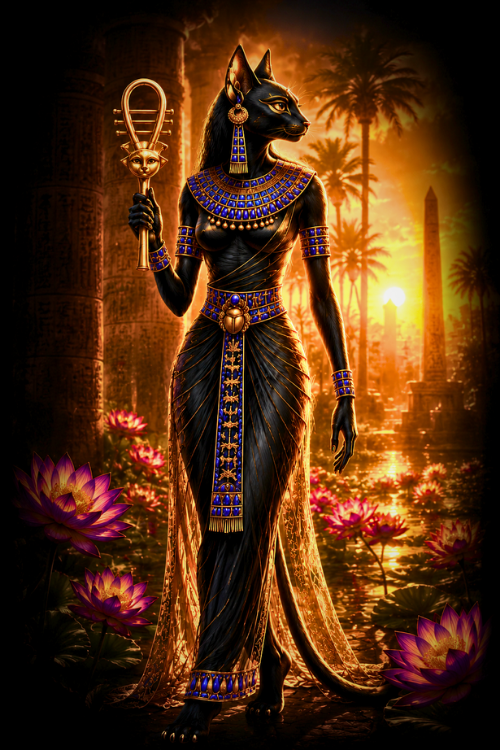
Over time, her image softened. By the New Kingdom, Bastet was increasingly depicted as a domestic cat or a woman with a cat’s head — graceful and elegant, yet never losing her inner strength. This shift is symbolic: wild power turned inward, placed in service of the home, the family, and the joy of living.
The main center of her cult was the city of Bubastis in the Nile Delta. Pilgrims flocked there each year for a festival in her honor — Herodotus described it as one of the liveliest and most crowded celebrations in Egypt, filled with music, dancing, and wine.
Symbolism and Domains
Bastet is associated with several key themes:
- Protection of home and family — in Egypt, cats guarded grain stores from rodents, and this very practical role grew into a spiritual one: Bastet protects the hearth from unwanted intruders, whether illness, conflict, or ill intentions.
- Feminine energy and fertility — as a mother goddess (in some myths, the mother of the lion god Maahes), she is tied to motherhood, childbirth, and feminine intuition.
- Joy, pleasure, sensuality — festivals in her honor centered on music, dance, and wine, reflecting an ability to enjoy life without guilt.
- The Moon — in later interpretations, Bastet was linked to lunar cycles and their influence on intuitive, hidden processes.
- Personal boundaries and grace — the feline nature teaches softness that can instantly become firmness when needed.
Tools for Working with Bastet’s Energy
If you plan to call on this archetype in practice, traditional correspondences include:
- Colors: gold, black, warm ochre
- Stones: tiger’s eye, amber, onyx
- Incense: myrrh, cinnamon, frankincense, jasmine
- Plants: catnip, lavender
- Symbols: the sistrum (an ancient musical instrument), a cat figurine, the eye symbol
A Note on Altar Centerpieces
You don’t need an authentic Egyptian antiquity to create a meaningful focal point — a small cat statuette works well as a stand-in for Bastet’s presence, or you can build the whole space around a dedicated altar cloth. A cloth gives you a contained, sacred “stage” for the candle, offering bowl, and other items, and can simply be folded away between rituals. If you’d like an example of what this looks like in practice, here’s a Bastet-themed altar cloth: Bastet Altar Cloth – Egyptian Cat Goddess. Either a statuette, a cloth, or both together work fine — choose whatever feels most resonant for you.
Ritual to Connect with Bastet: “Restoring Domestic Joy and Protection”
This ritual is suited for anyone wanting to restore a sense of safety at home, invite lightness and joy into daily life, and gently strengthen personal boundaries.
When to Perform It
The best timing is a Friday evening, or during the new moon/waxing moon, which symbolically supports new beginnings. Your own birthday also works well as a personal “Bastet feast day.”
What You’ll Need
- A gold, orange, or black candle
- A small dish of milk or honey (a traditional offering for cat-spirit guardians)
- A sprig of lavender, or a pinch of cinnamon or frankincense for scent
- A cat statuette or image — or, if you prefer, an altar cloth as the visual centerpiece (see above)
- Paper and a pen
Steps
1. Prepare the Space Clear your altar area or workspace. Light your incense and let the smoke fill the room briefly — a symbolic clearing of stagnant energy.
2. Light the Candle As you light it, say aloud or silently:
“Bastet, guardian of the threshold, I light this flame in your honor. Let its light become a doorway between my home and your protection.”
3. The Offering Place the dish of milk or honey in front of the candle as a symbolic gift. This is a gesture of gratitude and openness, not a literal sacrifice — you can remove it afterward, or, if it’s pet-safe, give it to a cat later (don’t consume it yourself).
4. State Your Intention Take your paper and write one sentence describing what you want to invite back into your home or life: ease, protection, joy, confidence in your boundaries. Phrase it in the present tense, as if already true — for example:
“My home is filled with warmth and safety,” “I assert my boundaries with ease,” “Joy is a natural part of my everyday life.”
Read the sentence aloud three times, picturing a cat resting calmly at the center of your home — a symbol that the space is protected.
5. Close the Ritual Let the candle burn down safely, or extinguish it and relight it for 10–15 minutes each evening over the following week if you’d like to extend the practice. Place the written sentence under your pillow, on your altar, or near your front door.
6. A Gesture of Gratitude To finish, gently stroke an imagined cat beside you (or a real one, if you have one), and say:
“Thank you, Bastet, for your protection and warmth. May my joy be a door through which only good things enter.”
After the Ritual
It’s considered a good sign if a cat crosses your path in the days following the ritual — on the street, in a video, in an image. Many take this as a sign the call was heard.